Key Insights
- Synopsys collaborates with NVIDIA to harness AI and accelerated computing for advanced engineering solutions.
- GPU acceleration through NVIDIA is significantly enhancing simulation speed and decreasing costs across industries.
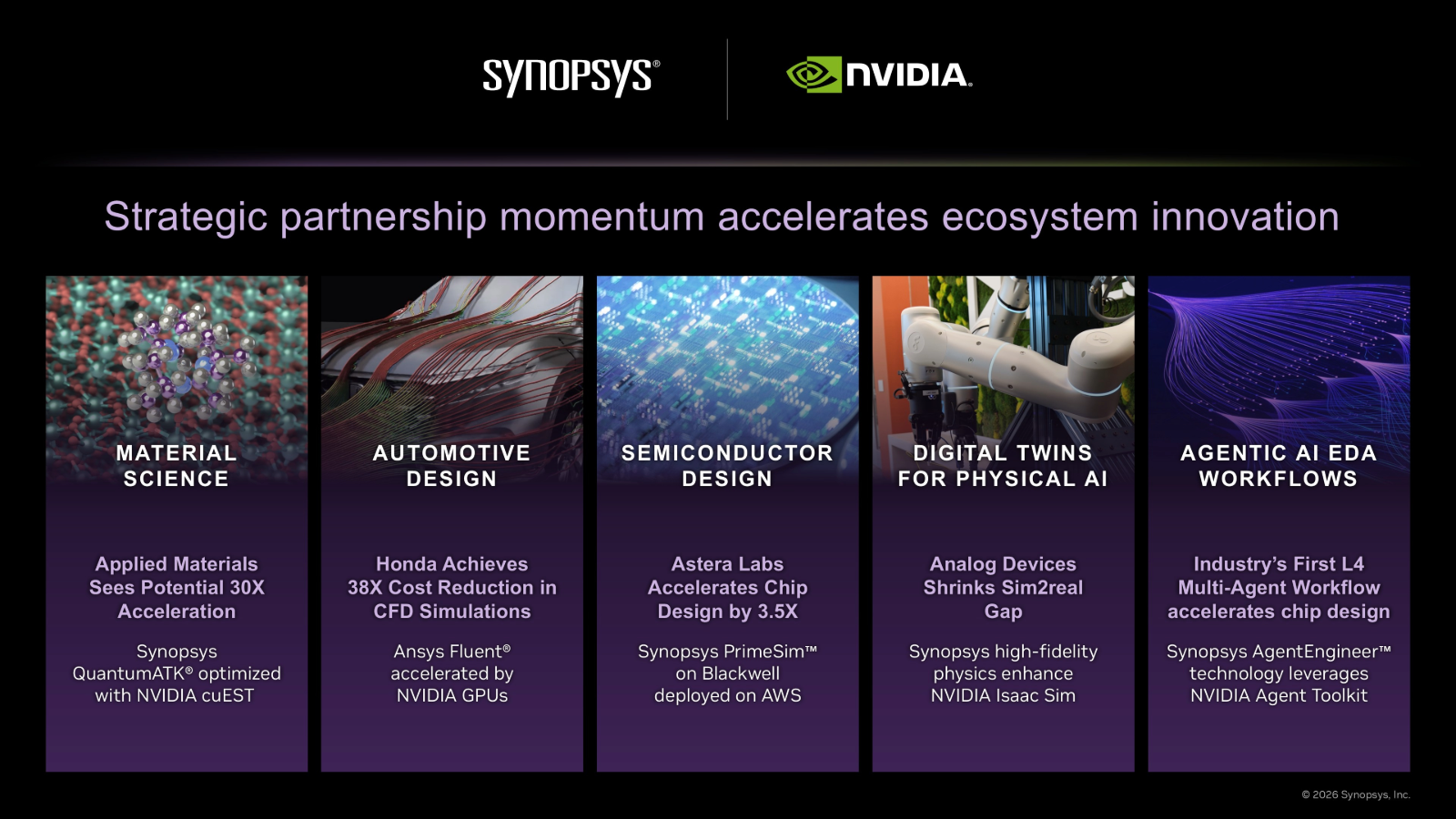
- Synopsys’ AgentEngineer™ leverages NVIDIA’s technologies to redefine electronic design automation in the AI era.
- Applied Materials and Honda report major performance gains using Synopsys and NVIDIA solutions.
- Digital twins, developed in tandem with NVIDIA, help Synopsys bridge gaps between simulation and real-world applications.
### Introduction
At the NVIDIA GTC 2026, Synopsys unveiled a groundbreaking partnership with NVIDIA aimed at transforming engineering and design across various industries. Their collaborative approach integrates NVIDIA’s advanced AI and accelerated computing capabilities with Synopsys’ market-leading engineering solutions. This union addresses the industry’s pressing challenges: complex workflows, increasing R&D costs, and the demand for quicker market launches.
### Unveiling of Strategic Partnerships and Innovations
Synopsys is heavily investing in co-developing a cutting-edge agentic AI stack in collaboration with NVIDIA. This initiative focuses on creating secure, hardware-accelerated workflows that cater to diverse use cases, from silicon to systems. Synopsys’ AgentEngineer™ leverages NVIDIA’s powerful AI technologies, allowing electronic design automation (EDA) workflows to orchestrate intricate chip design tasks at an unprecedented scale, thereby redefining how silicon is approached in the AI era.
### Innovations Driven by GPU Acceleration
Customers across the spectrum are reaping the benefits of Synopsys’ GPU-accelerated engineering applications powered by NVIDIA. Companies like Applied Materials are exploring AI and quantum chemistry research advancements, leveraging Synopsys QuantumATK® with NVIDIA cuEST to achieve significant speedups, enhancing simulation processes critical for semiconductor device development.
Honda has shifted its Computational Fluid Dynamics (CFD) workloads from traditional CPUs to NVIDIA GPUs, achieving substantial computational and cost reductions. Such transitions exemplify how AI and GPU technologystandards are reshaping automotive product development.
### Driving Next-Gen Chip Design and Connectivity
In the pursuit of scaling AI infrastructure, Synopsys offers solutions like PrimeSim™ that facilitate robust chip design for AI connectivity. Astera Labs, leveraging AWS’s NVIDIA-backed infrastructure, reported a 3.5X speedup in high-speed connectivity simulations. This innovation ensures next-gen connectivity solutions reach the market rapidly and more efficiently.
### The Potential of Digital Twins in Industrial AI
The development of digital twins is pivotal in bridging the gap between simulation and real-world scenarios. With Synopsys’ solutions integrated into NVIDIA platforms, high-fidelity digital twins become key tools in enhancing accuracy for robotic systems and manufacturing processes. Companies like Analog Devices, utilizing these simulational assets, demonstrate the capabilities of digital twins in progressing product design and reducing developmental iterations.
### Conclusion
Synopsys and NVIDIA’s synergy is not only revolutionizing traditional engineering methods but is also setting a new paradigm in digital engineering design practice. Their partnership serves as an archetype of how AI and accelerated computing can foster remarkable innovation across various sectors, ultimately driving efficiency and creativity for future developments.