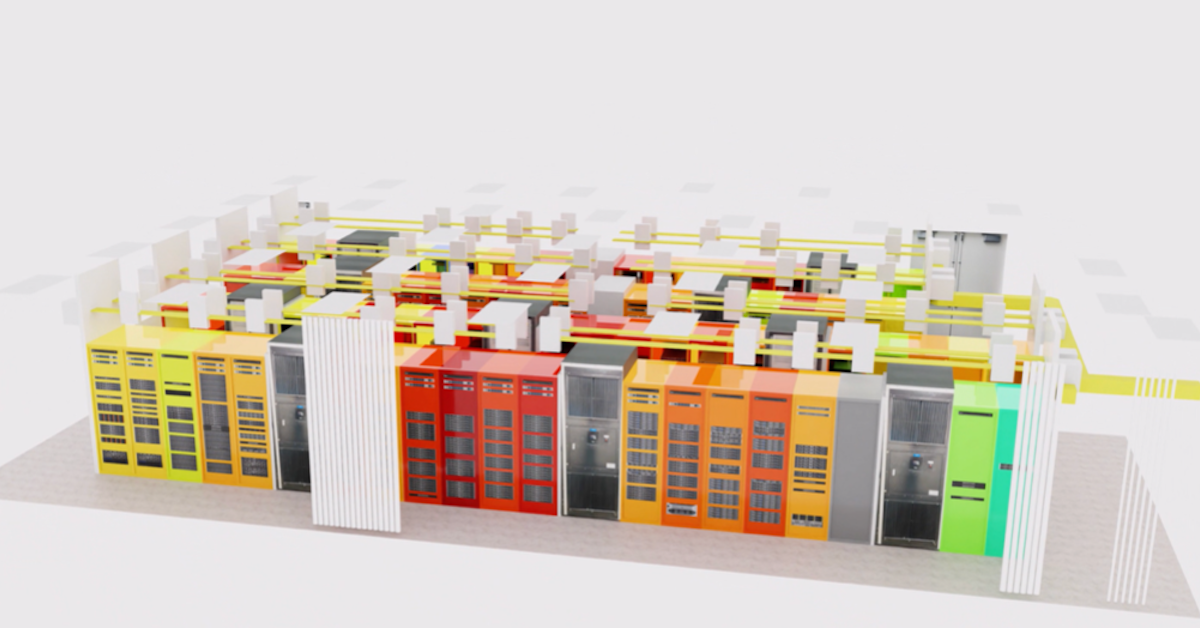
Key Insights:
- AI factories require a dynamic shift from traditional, static capacity planning to continuous, real-time optimization via digital twins.
- Physics-trained AI surrogate models provide rapid, accurate insights by embedding sophisticated CFD capabilities into AI infrastructure management.
- The Cadence Reality Digital Twin Platform fosters a seamless integration of AI and simulation, optimizing facility decisions with unprecedented speed.
- By utilizing GPU-accelerated CFD, Cadence dramatically reduces simulation times, enhancing decision-making agility without sacrificing precision.
- Continuous learning through the digital twin ensures that operational decision-making aligns closely with real-time data and evolving conditions.
### Transforming AI Infrastructure with Physics-Trained AI
The burgeoning growth of AI factories has placed unprecedented demands on data center infrastructure management, compelling a shift from traditional capacity planning methodologies. As AI workloads exert significant pressure on power, cooling, data, and spatial resources, the Cadence Reality Digital Twin Platform introduces an innovative, multi-faceted solution leveraging AI capacity agents and physics-trained surrogates.
### The Breakdown of Conventional Capacity Planning
High-density GPU systems, particularly NVL72 rack scale systems, push thermal and electrical limits, leaving narrow operational margins. Traditional full CFD simulations yield the necessary precision but are too computationally intensive for evaluating myriad workload placement scenarios in real-time. Consequently, operational teams frequently face trade-offs between speed and accuracy, often compromising either confidence or agility.
### The Cadence Reality Solution
Cadence Reality Digital Twin Platform addresses these inefficiencies by embedding AI surrogate models into the digital twin workflow. These surrogates are trained using physics-based solvers, capturing intricate thermal and airflow dynamics, emulating control systems, and responding to AI workloads with speed and precision. This method not only aligns with digital twin best practices but markedly accelerates prediction, delivering real-time insights at scale.
### Real-Time Decision-Making at Scale
Integrating trained AI surrogates into the digital twin allows for near-real-time thermal inferences. Teams can now explore workload placement options quickly, determine feasible deployment zones, and assess risks with newfound agility. The process has transformed from a cumbersome batch operation to a dynamic, interactive exercise, enabling rapid “what-if” scenario evaluations.
### Accelerated Validation with GPU-Accelerated CFD
When higher fidelity validation is imperative, Cadence Reality integrates GPU-accelerated CFD, leveraging NVIDIA Omniverse libraries. This setup completes full CFD runs significantly faster than traditional methods, facilitating a broader exploration of potential setups. AI surrogates narrow choices swiftly, while GPU-accelerated CFD provides validation with physics-grade accuracy, marrying speed with precision seamlessly.
### The Cadence AI Capacity Agent
At the heart of Cadence Reality is the AI Capacity Agent—a decision engine evaluating capacity in real-time, ranking deployment options, and recommending candidates for detailed CFD validation. This sophisticated agent ensures decisions are fast yet grounded in rigorous accuracy, balancing AI insights with physical validation.
### Continual Learning and Optimization
The digital twin’s continual evolution reflects facility changes, incorporating new data and outcomes to refine surrogate models over time—creating a feedback loop that integrates design intent with operational realities. This continuous learning framework optimizes decisions, grounded in physics and confirmed before execution.
### Broadening AI Infrastructure Approaches
Cadence envisions these agentic AI principles not only improving semiconductor design but extending to physical AI infrastructures like on-premises GPU data halls. By optimizing facilities alongside chip design, Cadence ensures that physical environments match the efficiency and reliability standards of the chips they house, reducing deployment risks and accelerating operational readiness.
In conclusion, the Cadence Reality Digital Twin Platform represents a cutting-edge blend of AI and simulation, providing an adaptable, scalable, and precise framework to manage, optimize, and expand AI infrastructures efficiently and accurately.
Source: Cadence