
Key Highlights & Insights
- The partnership between Samsung and AMD aims to develop advanced memory solutions for AI, enhancing performance and efficiency.
- Samsung will supply HBM4 for AMD's upcoming AI accelerators, such as the Instinct MI455X GPU.
- The companies will collaborate on DDR5 memory solutions optimized for the AMD EPYC CPUs, targeting next-generation AI infrastructure.
- Potential foundry collaborations are on the horizon, showcasing Samsung's fabrication strength and AMD's design capabilities.
- This collaboration extends their two-decade history of innovation across various technology sectors.
Strategic Alliance Enters New Era
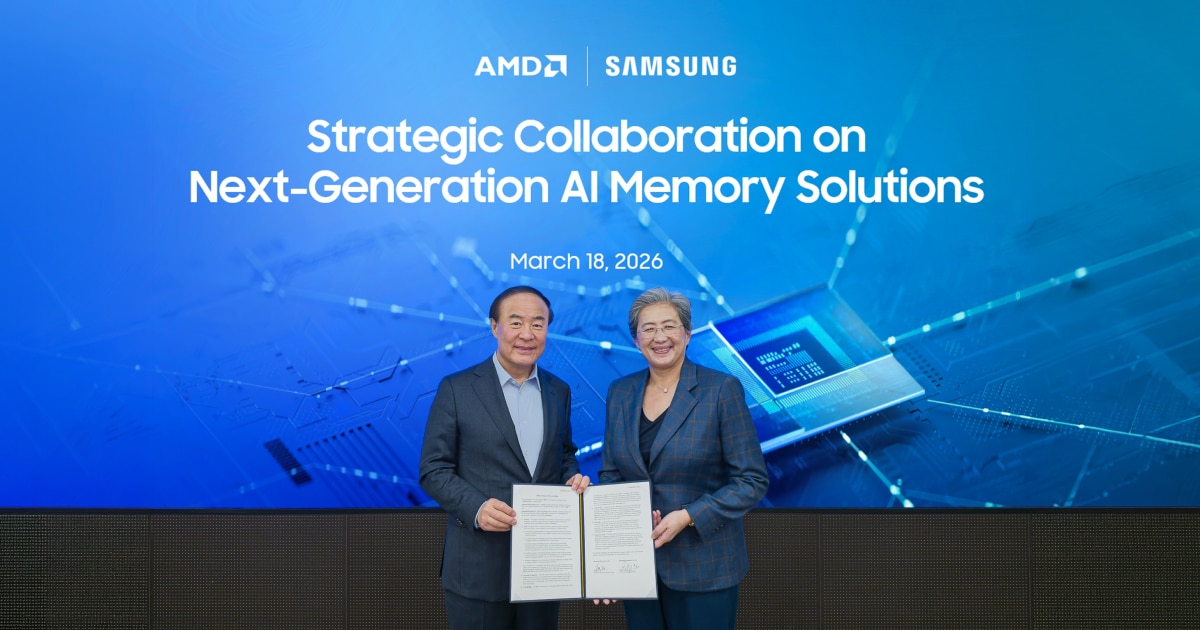
Samsung Electronics and AMD have inked a new Memorandum of Understanding (MOU) that builds on their strategic partnership to focus on next-generation memory solutions tailored for artificial intelligence (AI) infrastructure. This collaboration signifies a reinforcement of ties between the two tech giants, aimed at driving advancements in AI computing and memory technologies.
Focus on Advanced Memory Technologies
The MOU, signed by Samsung’s Vice Chairman & CEO Young Hyun Jun and AMD’s Chair and CEO Dr. Lisa Su, emphasizes enhancing High Bandwidth Memory (HBM4) and DDR5 solutions to support AMD’s AI accelerators, CPUs, and rack-scale platforms. The agreement is a testament to the mutual commitment of both companies towards improving AI infrastructure efficiency and scalability.
High Bandwidth Memory 4 (HBM4) and 6th Gen DDR5
A key component of this agreement is Samsung’s role as the primary supplier of HBM4 for the AMD Instinct MI455X GPU. Samsung’s advanced 6th-generation 10-nanometer-class DRAM process is noted for its impressive 13GBps processing speeds and a bandwidth of 3.3 terabytes per second, exceeding industry standards. This performance boost is crucial for handling demanding AI workloads efficiently.
DDR5’s role in the collaboration is equally significant, with a focus on delivering high-performance memory for AMD’s 6th Gen EPYC CPUs. These technologies are pivotal for the Helios platform that supports scale-out, high-performance AI systems.
Manufacturing and Foundry Synergies
The MOU also outlines prospective discussions on foundry partnerships, in which Samsung could potentially provide manufacturing services for AMD’s future products. Samsung’s expertise in chip fabrication complements AMD’s semiconductor design prowess, potentially leading to breakthroughs in AI computational capabilities.
A Legacy of Collaborating for Innovation
Both companies have a history of collaboration, having worked together on graphics, mobile, and computing technologies, with Samsung previously as AMD’s HBM3E partner. This enduring partnership allows them to leverage shared experiences and build upon past successes to tackle the complexities of future AI and computing needs.
Broader Implications for the Tech Industry
The Samsung-AMD alliance represents more than just a corporate partnership; it is a strategic move that could reshape the competitive landscape of AI computational technologies. By optimizing system-level performance through collaborative innovation, they aim to meet the growing demands for energy-efficient, high-performance computing, which are critical as AI continues to evolve and expand across industries worldwide.
Report compiled by EDA Editorial Desk. Content and images sourced from original announcements published by Samsung. This analysis constitutes transformative, educational news aggregation.